
Subtotal $0.00
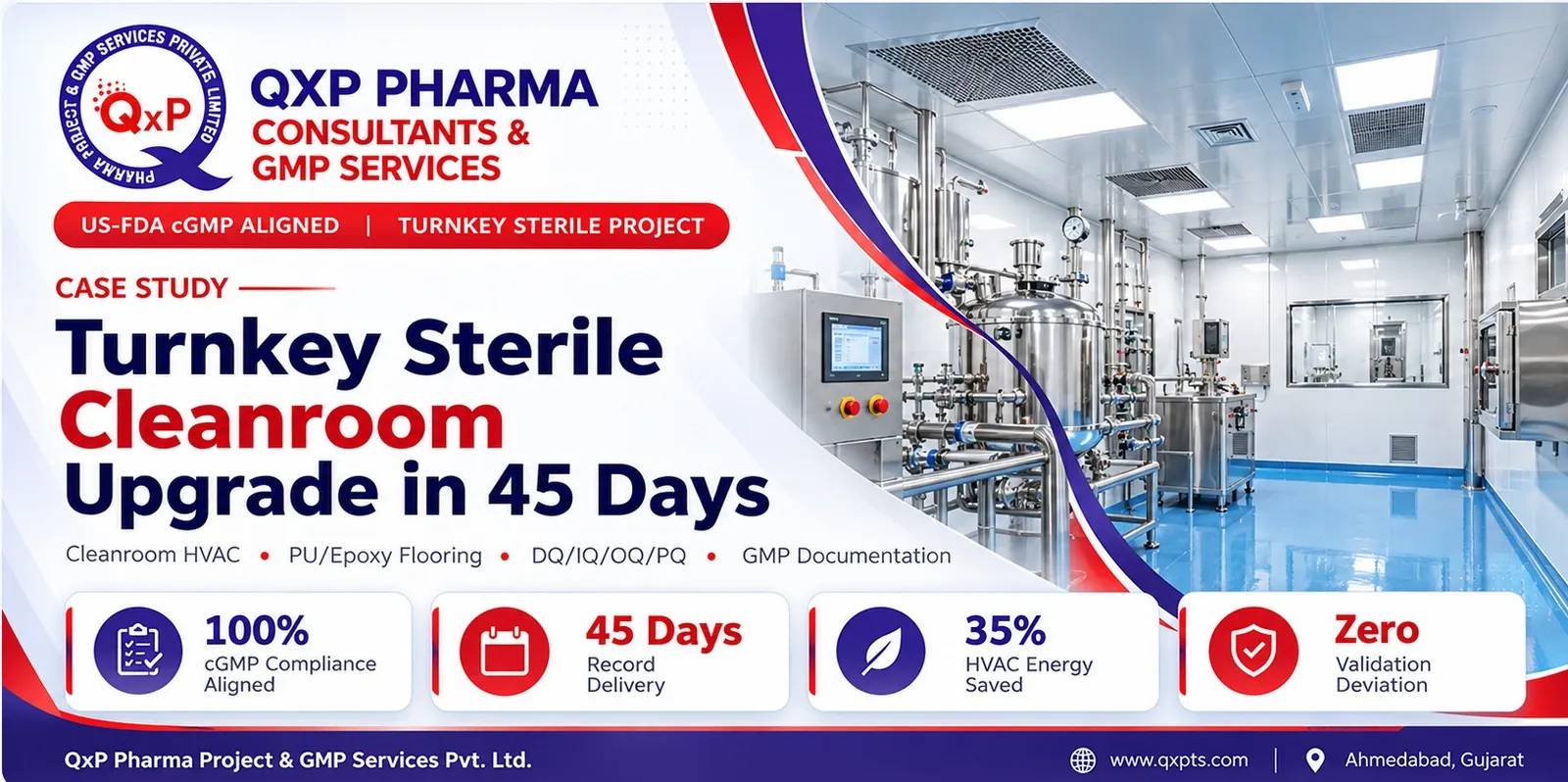
US-FDA CGMP ALIGNED | TURNKEY STERILE PROJECT
Turnkey Project
How QxP delivered a US-FDA cGMP-aligned sterile cleanroom upgrade in just 45 days, with a 35% reduction in HVAC energy consumption and zero validation deviations, under single-point turnkey accountability.
100%
CGMP Compliance Aligned
45 Days
Record Delivery
35%
HVAC Energy Saved
Zero Deviation
Validation Standard
The Operational & Technical Challenge
A sterile injectables manufacturer in Gujarat needed to upgrade an existing filling and compounding area to meet current US-FDA cGMP expectations before an upcoming customer audit. The existing setup had four problems:
The HVAC system could not hold stable pressure differentials between ISO 7 and ISO 8 zones.
Particle counts were inconsistent during operations.
Old flooring and wall joints were hard to sanitize.
Three separate vendors handled civil, HVAC and validation, which created coordination gaps and a risk of missing the audit date.
The client could not afford a long shutdown. They needed one accountable partner who could design, build, qualify and hand over a compliant area within a tight window.
Our Strategic Engineering & GMP Solution
QxP took full turnkey ownership and ran every workstream in parallel instead of one after another.
Gap assessment and design: We reviewed the existing layout against US-FDA cGMP (21 CFR Parts 210/211), EU GMP Annex 1 and Schedule M principles. We redesigned material and personnel flow to reduce cross-contamination risk.
Cleanroom HVAC redesign: We optimized air changes per hour, HEPA filtration and pressure cascades. VFD-controlled air handling units and optimized airflow design cut energy use without affecting classification.
Construction: We installed modular cleanroom partitions with flush, coved joints and seamless PU/Epoxy flooring for easy cleaning and sanitization.
Qualification and validation: We executed DQ, IQ, OQ and PQ with HEPA integrity testing, airflow visualization, particle counts and recovery studies.
Documentation: We prepared the SOPs, validation protocols and reports, and the audit-ready documentation pack, so the client team was inspection-ready at handover.
Because civil, HVAC and validation teams worked from one schedule, the site went from planning to handover in 45 days.
The Measured Results & Compliance Outcome
Compliance: The area was handed over fully aligned with US-FDA cGMP requirements, with a complete documentation trail.
Speed: The project was completed in 45 days. That was ahead of the client’s internal timeline and well before their customer audit.
Energy: HVAC energy consumption fell by about 35%, which lowers the client’s long-term operating cost.
Quality: There were zero critical or major deviations during qualification, and the cleanroom held its ISO classification throughout the PQ runs.
Accountability: One partner, one schedule and one point of contact replaced three vendors.
Key Takeaways:
- One turnkey partner removed vendor coordination gaps.
- Parallel execution of civil, HVAC and validation saved weeks.
- Optimized HVAC design cut energy use without compromising ISO classification.
- Audit-ready documentation was delivered at handover.
FAQs
Q1. Can a sterile cleanroom upgrade really be completed in 45 days?
- Yes, when the scope is a defined cleanroom suite upgrade and civil, HVAC and validation run in parallel under one plan. A full greenfield plant takes far longer, typically 12 to 24 months depending on dosage form.
Q2. How does a turnkey approach reduce compliance risk?
- GMP requirements are built into design and construction decisions from day one, so they are not checked after the work is done. That prevents costly retrofitting.
Q3. How is HVAC energy saving achieved in a cleanroom?
- Through optimized air change rates, VFD-driven air handling units, efficient filtration design and proper pressure-cascade control, all without compromising the room’s ISO classification.
Q4. Does QxP handle validation as well as construction?
- Yes. QxP covers DQ, IQ, OQ and PQ, HEPA integrity testing, SOPs and the complete GMP documentation pack.
Planning a cleanroom upgrade or a new GMP facility? Talk to QxP’s turnkey experts for a free project discussion.
““QxP took ownership of the entire project, from design to validation. Having one accountable team meant no delays between vendors, and our documentation was audit-ready on day one. The energy savings from the new HVAC design were a real bonus.””