


Subtotal $0.00
ANNOUNCEMENT
Announcement
Schedule M Compliance for MSME Pharma Units: What the Extended Deadline Means
Schedule M compliance has become the top quality priority for Indian drug manufacturers, especially small and medium units. The Health Ministry revised Good Manufacturing Practices (GMP) under the Drugs and Cosmetics Rules to match global standards. As a result, every plant must now upgrade its systems, documents and facilities.
India has around 10,500 drug manufacturing units, and about 8,500 of them are MSMEs. Therefore, the rules affect most of the industry. This guide explains the timeline, the key changes and a practical way to prepare.
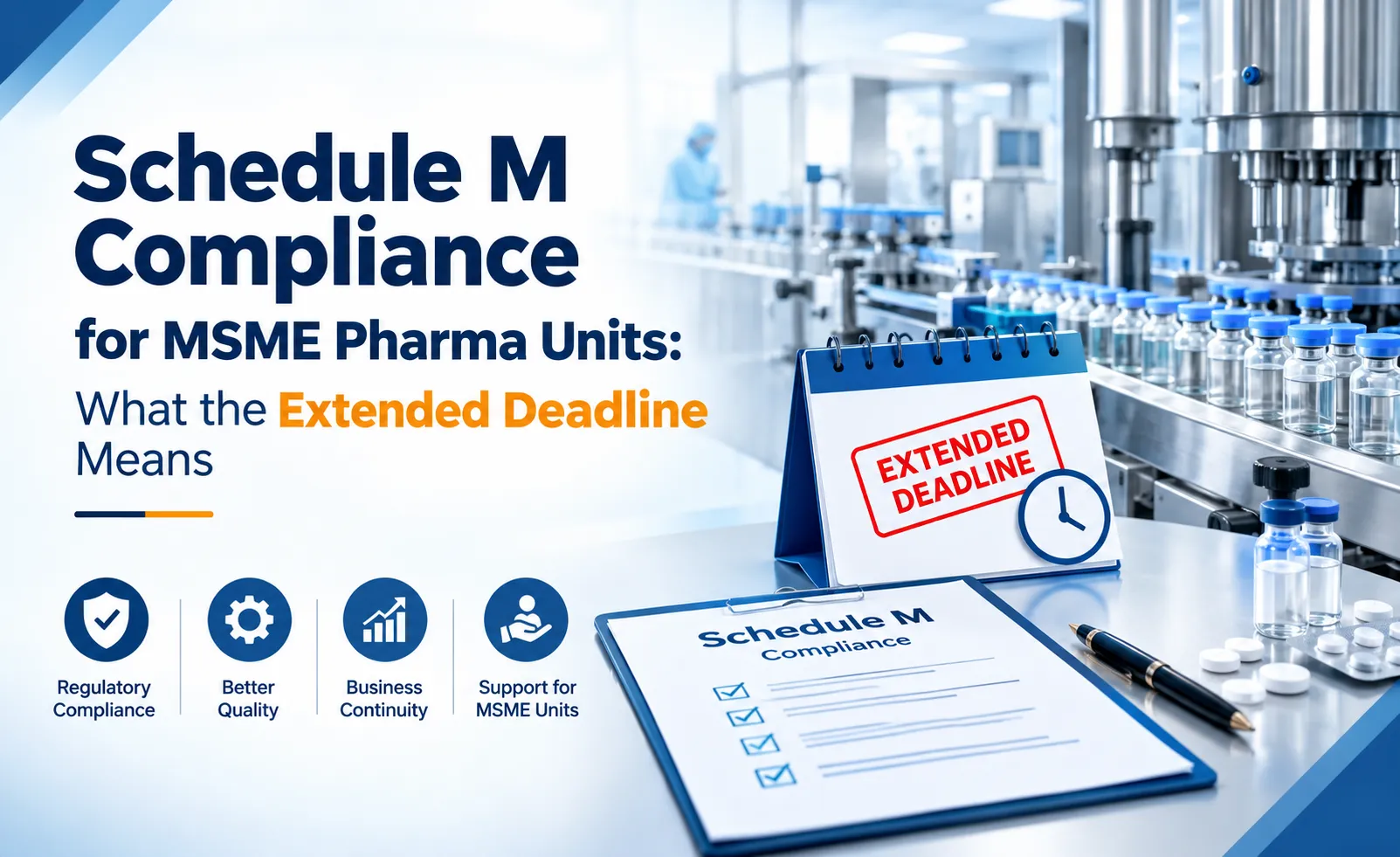
Schedule M compliance checklist for MSME pharma manufacturing unit
Image alt text: Schedule M compliance checklist for MSME pharma manufacturing unit
What Is Revised Schedule M?
Schedule M lays down the GMP requirements for premises, plant, equipment and processes. The Ministry notified the revised version in December 2023, and the rules were published on 5 January 2024. They aim to bring India’s norms in line with World Health Organization (WHO) expectations. They also help ensure that Indian medicines meet globally accepted quality levels.
The revised rules focus on controlling materials, methods, machines, processes, personnel and the facility environment. In short, quality must be built into every step instead of being tested at the end.
Who Needs Schedule M Compliance, and By When?
The deadline depends on company turnover. Initially, large manufacturers (turnover above Rs 250 crore) got six months. MSMEs (turnover below Rs 250 crore) got twelve months, which meant a deadline of 1 January 2025.
However, industry bodies asked for more time, mainly because upgrades need money and planning. In response, the Health Ministry gave MSMEs another twelve months, up to 31 December 2025. To qualify, units had to:
- Register with CDSCO within three months.
- Share a clear plan to upgrade their facilities.
- Accept an audit of that plan afterwards.
That extended deadline has now passed. Since then, the DCGI has asked state regulators to begin inspections. Units that were granted an extension had an effective date of 1 January 2026. Consequently, strict action is possible wherever a plant falls short.
Key Changes Your Plant Must Address
The revised GMP introduces several system-level requirements. Notably, these include:
- Pharmaceutical Quality System (PQS): a documented system that manages quality across the whole product lifecycle.
- Quality Risk Management (QRM): a structured way to identify and control risks.
- Product Quality Review (PQR): a regular review of each product’s data and trends.
- Equipment qualification and validation: proof that machines and utilities work as intended.
- Computerised storage system: controlled, traceable records for drug products.
Moreover, new categories such as products with hazardous substances, biologicals and radiopharmaceuticals now carry specific requirements.
Why Schedule M Compliance Matters for Exports
India supplies medicines to many low- and middle-income countries, and these buyers often require WHO GMP certification. Currently, only about 2,000 MSME units hold it. As a result, a unit that meets the revised standard can win export orders and build buyer trust. On the other hand, a non-compliant unit risks inspection findings, penalties and lost contracts.
Meanwhile, regulators are actively checking progress. CDSCO has already inspected over 800 manufacturing units and 252 public testing labs. It has also held 15 awareness sessions with more than 36,000 attendees.
How to Prepare: A Practical Roadmap
A step-by-step approach keeps the upgrade manageable:
- Run a gap assessment. Compare your current setup with each clause of the revised schedule.
- Prioritise critical gaps. Start with HVAC, water systems, cleanrooms and documentation.
- Upgrade the facility. Fix layout, flooring, partitions and utilities where needed.
- Complete qualification and validation. Cover equipment, utilities, processes and computer systems.
- Build your quality system. Set up SOPs, change control, deviation handling and PQR.
- Train your people. Staff must understand and follow every procedure.
- Hold a mock audit. Test your readiness before the regulator arrives.
How QxP Pharma Can Help With Schedule M Compliance
QxP Pharma Project & GMP Services supports plants through each stage of this journey. For example, our team offers a site gap assessment audit to find weak spots early. We also handle qualification and validation, computer system validation and complete GMP compliance and regulatory support. If your plant needs structural upgrades, our plant modification and turnkey project services can help.
Ready to start? Contact our team for a free discussion about your facility.
Conclusion
Schedule M compliance is no longer optional, and the extended deadline has passed. Therefore, MSME pharma units should act now: assess gaps, upgrade systems and prepare for inspections. Doing so protects your licence and also opens doors to global markets.
Sources: DT Next / PTI report on the MSME extension, GMP-Compliance.org on the revised rules
Frequently Asked Questions
Q. What is Schedule M in pharma?
- Schedule M sets the Good Manufacturing Practices (GMP) for pharmaceutical products in India. It covers premises, plant, equipment, processes, personnel and the facility environment. The revised version was notified in December 2023 to align Indian norms with WHO standards and to improve drug quality.
Q. Who must follow the revised Schedule M?
- All drug manufacturing units in India must follow it. Large manufacturers (turnover above Rs 250 crore) had six months to comply. MSMEs (turnover below Rs 250 crore) had twelve months, followed by an extension for eligible units.
Q. What was the extended deadline for MSME pharma companies?
- The Health Ministry gave eligible MSMEs an extra twelve months, up to 31 December 2025. Units had to register with CDSCO within three months and share a plan to upgrade their facilities. That extended deadline has now passed.
Q. What are the key changes in the revised Schedule M?
- The main additions are a Pharmaceutical Quality System (PQS), Quality Risk Management (QRM) and Product Quality Review (PQR). It also requires equipment qualification and validation, plus a computerised storage system for drug products. Specific rules now apply to biologicals, radiopharmaceuticals and products with hazardous substances.
Q. What happens if a unit does not comply with Schedule M?
- The DCGI has asked state and UT regulators to inspect units and take strict action against non-compliance. Action is taken under the Drugs and Cosmetics Act and its rules. Therefore, non-compliant units risk penalties, regulatory action and loss of business.
Q. Is Schedule M the same as WHO GMP certification?
- No. Schedule M is the Indian legal requirement, while WHO GMP is an international certification. The revised Schedule M was designed to match WHO expectations closely. Many low- and middle-income countries ask for WHO GMP, so strong Schedule M compliance supports exports.
Q. How can an MSME prepare for Schedule M compliance?
- Start with a gap assessment against each clause of the schedule. Then fix critical areas such as HVAC, water systems and documentation, and complete validation. Finally, train your staff and run a mock audit before the regulator visits.
Q. How can QxP Pharma help with Schedule M compliance?
- QxP Pharma Project & GMP Services offers site gap assessment audits, qualification and validation and GMP compliance support. The team also handles plant upgrades and turnkey projects. Contact us to discuss your facility.